
Healthcare
Xenter
Real-time cardiac AI, designed for an FDA setting
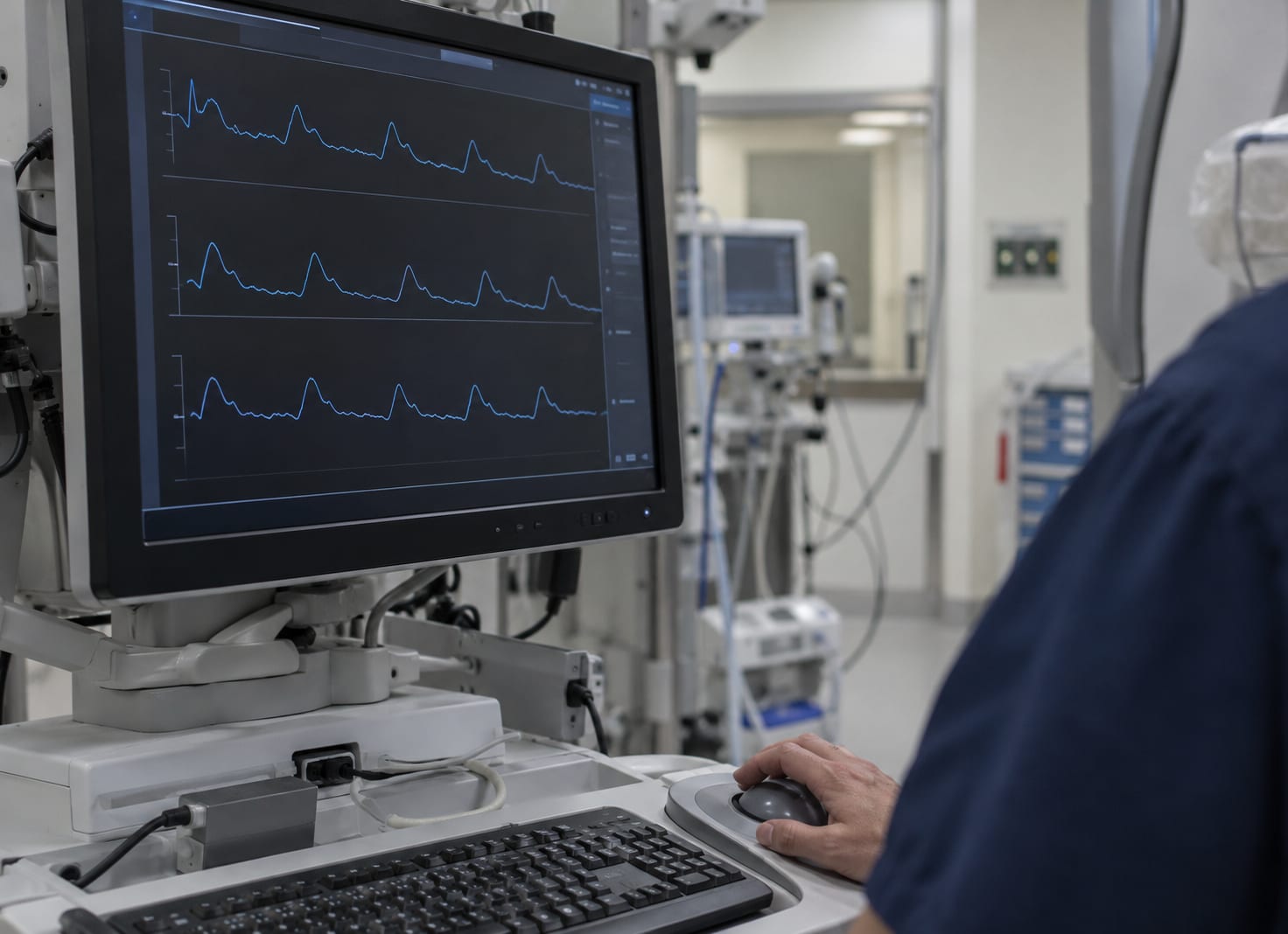
Xenter’s sensors record the heart’s pressure waveform in more detail than a clinician can read live. AE Studio designed the AI system that reads it during a procedure and the AI assistant that lets patients ask about their own results, inside FDA and HIPAA boundaries, with guardrails, evaluations, and an FDA pathway mapped together with Xenter.
TL;DR
- Models read Xenter’s live pressure waveform during a procedure and give the clinician a valve-leak severity estimate on the local device, with no internet dependency.
- A patient AI assistant answers questions from the patient’s own records inside an FDA-compliant scope, backed by guardrails and an evaluation suite that tests every change before it ships.
- The FDA pathway for the prediction model, including the clearance route and the data a submission would need, was mapped together with Xenter alongside the modeling.
Compliance & data handling
- HIPAA
- FDA
Prediction models run on Xenter’s local hub device with no internet dependency. Every access to patient data is logged to a HIPAA-aligned audit trail, and the FDA pathway for the prediction model was mapped together with Xenter.
The challenge
The problem.
Xenter makes smart wireless devices and diagnostics for interventional cardiology, and its sensors stream the heart’s pressure waveform at a fidelity not previously available. In a procedure, though, that signal was still only as useful as what an experienced clinician could read by eye, so the finer insights in the data went unused. Xenter also wanted patients to be able to ask about their own results after a procedure, and anything it put in front of a clinician or a patient had to live inside FDA and HIPAA boundaries, where every prediction, prompt, and answer has to be evaluated, guarded, and auditable.
With AE Studio, Xenter has a system that reads that waveform during a procedure and gives the clinician a valve-leak severity estimate, on the local device with no internet dependency, and an AI assistant that lets a patient ask about their own results and get answers drawn from their own records, scoped so it explains rather than diagnoses.
Both came with guardrails, an evaluation suite, and the FDA pathway work done together with Xenter, from one team covering data science, engineering, product, and regulatory research.
The solution
What we built.
Live Predictions From the Waveform
AE developed models that read Xenter’s live pressure waveform during a procedure and estimate the severity of a valve leak, combining multiple signals into a single clinical severity score with confidence bands rather than a bare number. Because real device recordings did not yet exist, AE trained the first models on simulated waveforms and validated them against recorded procedures and mechanical heart data as those became available. The models run on Xenter’s local hub device with no internet dependency, so predictions arrive at the bedside in real time.
A Patient Assistant Grounded in the Patient’s Own Records
AE designed an AI assistant for Xenter’s patient app that lets a patient ask about their own results, with answers that reference their health records. It explains concepts and restates the patient’s own measured values, and it does not interpret or diagnose, a boundary checked against the limits leading patient-facing clinical AI products use. A companion assistant for physicians answers questions over scoped clinical data with source attribution, and drafts post-discharge reminders that go out only after a physician approves them.
Guardrails and Evaluations That Make Safety Measurable
Every assistant response passes through guardrails that screen incoming messages, including emergencies and adversarial attempts, and block unsafe content on the way out, with every access to patient data logged to a HIPAA-aligned audit trail. An automated evaluation suite runs with the guardrails in the loop, so any change to a prompt or model is measured before it ships, and a voice-and-tone review of every evaluated response feeds clinical and legal decisions.
A Bedside View Designed With Clinicians
AE integrated live predictions into the bedside monitor view and redesigned the presentation with cath-lab clinicians, moving from raw numbers toward categorical severity (mild, moderate, severe) and a visual severity map that matches how clinicians decide.
Regulatory Groundwork and a Research Portal
Working with Xenter, AE mapped the FDA pathway for the prediction model, including the clearance route and the data a submission would need, analyzed the clinical decision support boundary, and defined an FDA-compliant scope for the patient assistant’s first release. Doing this alongside the modeling means Xenter’s regulatory track starts from a written pathway for the AI rather than working one out after the fact. For Xenter’s research team, AE stood up a portal that queries across simulation data, public ICU data, and medication databases and flags missing data.
Outcomes
What shipped.
The work had two main pieces, machine learning on the waveform and a patient-facing AI assistant for a clinical setting, delivered with the guardrails, evaluations, and FDA pathway work that let a medical device company put them in front of clinicians and patients.
A system that reads the waveform during a procedure and gives the clinician a valve-leak severity estimate, on the local device with no internet dependency
An AI assistant that lets patients ask about their own results and answers from their own records, scoped for an FDA-compliant first release
A physician assistant that answers over scoped clinical data with source attribution and drafts follow-ups a physician approves
Any change to a prompt or model is evaluated before it reaches a clinician or patient, so Xenter can keep improving the assistant without a fresh manual safety review each time
The FDA pathway for the prediction model mapped out with Xenter, including the clearance route and the data a submission will need
Key takeaways
What we learned.
- Richer sensor data needs software to read it. Hardware that captures a finer signal only pays off once a model can turn it into something a clinician can use.
- Simulated data can start a regulated ML program. Training on simulation and validating on recorded data as it arrived let modeling begin months before the devices could produce usable training data.
- Scope the patient assistant by regulation first. Deciding what the assistant will not do, interpret or diagnose, is what made a patient-facing release possible.
- Test safety on every change. Evaluating with the guardrails in the loop turns every prompt or model change into a repeatable check.
- Regulatory work belongs inside the engineering team. Mapping the FDA pathway alongside the models kept the two aligned instead of forcing a retrofit.
In summary
Bottom line.
Xenter’s sensors record more than a clinician can read live. AE Studio designed the system that reads it during a procedure and the AI assistant that lets patients ask about their own results, with guardrails, evaluations, and an FDA pathway mapped together with Xenter, so the AI and its path to clearance moved forward at the same time.
FAQ
Frequently asked.
What does the AI actually predict?
Does it run in the cloud?
What can the patient assistant say?
How is safety enforced?
How does this relate to FDA clearance?
Let's talk
Bring us the hard problem.
We'll bring the team that ships.