
AI agents
AI Operating Model: Your Org Chart Was Built for a World Without AI
78% of companies use AI and only 1% are mature at it. The bottleneck is an operating model built for a world without AI. A short read for CEOs on where to start.
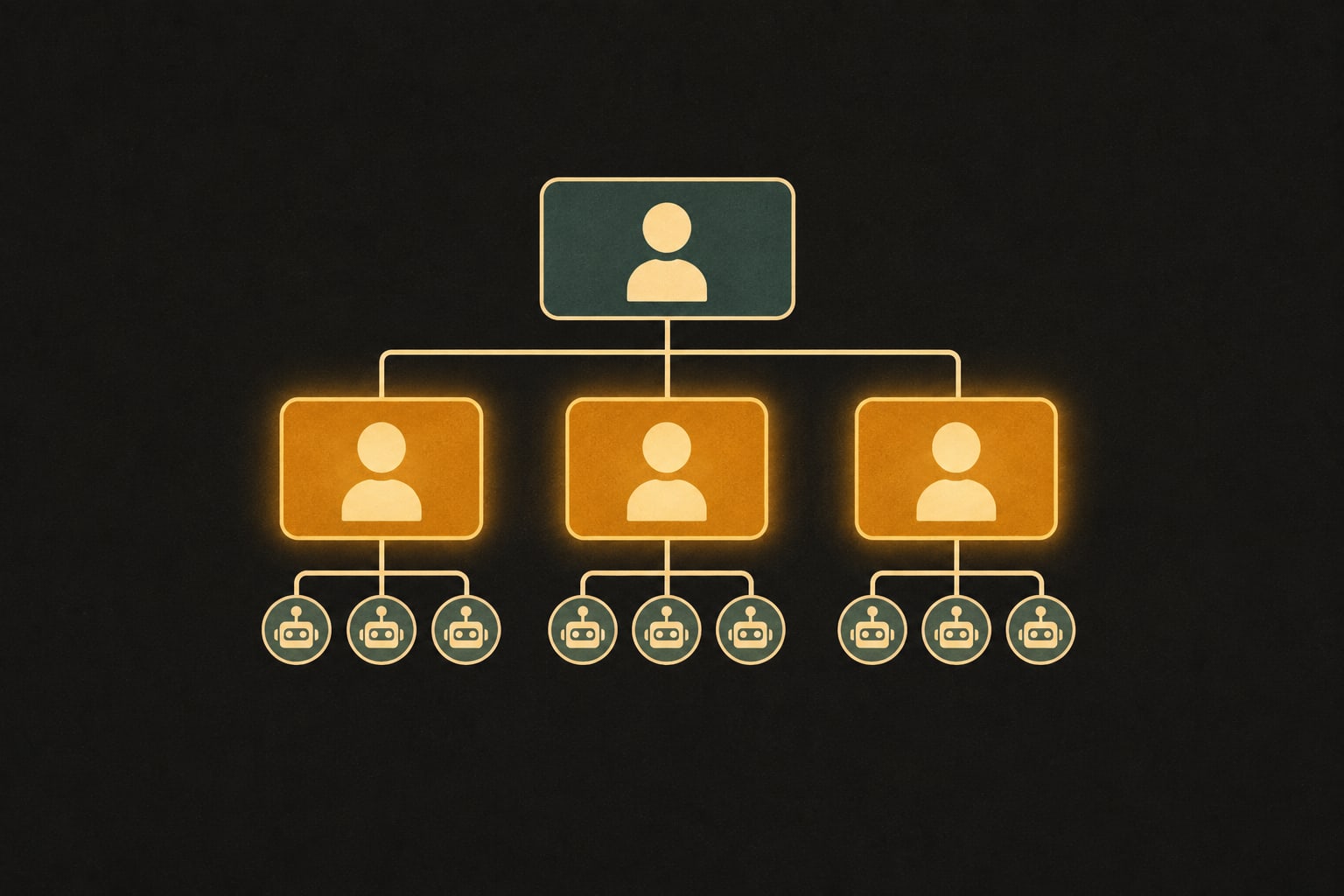
Think about a normal week at your company. Smart, well-paid people spend hours gathering updates. Then they rewrite them. Then they reformat them for a different audience. Then they route them up the chain so someone further up can look at them and make a decision.
That isn't a bug. That's what the whole middle of a company is optimized to do.
AI changes the cost of exactly that work. When the cost of work this large changes, your AI operating model and your org chart need to change with it, and that change is due this year.
The real question this year isn't "how do we use AI more." It's: what is your org currently optimized for, and is that still the right answer?
We just spent a 60-minute webinar making this case to a room of CEOs, CIOs, and operators. We called it Agents in the Org Chart. This is the short, written version, aimed at the person reading it between two meetings.
AI adoption is nearly universal and value is still rare
Three numbers sit on top of this whole conversation.
78% of organizations say they're using AI. That's McKinsey's 2024 Global Survey on AI, roughly 1,500 executives and senior leaders. Adoption is essentially universal.
5% are capturing AI value at scale. From BCG's 2024 cross-industry value study, 1,000+ C-suites across 50+ markets. They filtered "value at scale" to measurable P&L impact, not pilots.
1% of leaders describe their own organization as mature in AI deployment. McKinsey, Superagency in the Workplace, 2025. Same senior leaders saying "yes, we're using it" are also saying "no, we're not mature at it." Even by their own generous standards, 1% think they're there.
AI is in the building. Value isn't. And that gap, 78% using and 1% mature, is the most interesting business question of the next two years.
Access to the models is a commodity. An AI operating model is how a company structures work, roles and decisions around AI models and agents, and it is now the limiting factor.
Why this is happening: AI lowers the cost of two things
If you walk away with one idea, make it this one.
AI lowers the cost of coordination and intelligence at the same time.
Coordination is the work that consumes the middle of your company every day. Gather. Summarize. Compare. Route. Decide. Those five verbs are most of what managers do, most of what ops does, most of what program management does. They're exactly what language models are best at.
Intelligence is the work that used to be cognitively expensive. Analyze. Synthesize. Investigate. Reason. The work that used to require an expensive senior, a decent first-pass analysis, a research synthesis, a reasoned tradeoff between options, is now a prompt away. Not perfect. Decent. And decent is a massive change when you used to pay an expert for a week to get there.
Both get cheaper at the same time. That isn't a productivity improvement. It's a change in the structural economics of the company.
Here's the kicker. Management doesn't disappear. It splits. The routing layer evaporates. The parts built for judgment, taste, coaching, and accountability become much more important than they are today.
How Block, Microsoft, Shopify, Meta and Ramp are changing their AI operating model
If you want to see where this goes, look at the companies most exposed to AI and what their CEOs are doing with their own orgs.
Block. Jack Dorsey's March 2026 essay, From Hierarchy to Intelligence. He's collapsing management into three kinds of roles: DRIs who own direction, player-coaches who develop craft and people while still doing the work, and builders who build. The sentence that matters: no permanent middle-management layer whose main purpose is information routing.
Microsoft. Their 2025 Work Trend Index introduces what they call the Frontier Firm: lean teams assembled around goals, agents as digital colleagues. The line that caught everyone is Satya's framing that "every employee becomes an agent boss." Not "uses AI." Manages agents. That's a job description change, not a tool rollout.
Shopify. Tobi Lütke's April 2025 memo. Reflexive AI usage is now a baseline expectation. Before any team asks for headcount, they have to show the AI-native version of the work first. That sentence changes every team proposal overnight.
Meta. Reality Labs, March 2026. New role taxonomy: AI Builder, AI Pod Lead, AI Org Lead. Smaller AI-native pods. Fewer layers between builders and leadership.
Ramp. Fintech, ~1,000 employees. Twelve months in: 99.5% of employees active on AI tools, 1,500+ internal apps built in six weeks by 800+ non-engineer builders, 12% of production PRs now coming from non-engineers.
Five very different cultures. One direction of travel. They aren't adding AI on top of the old org. They're changing the shape of it.
The strategic question most CEOs duck
Say AI makes your team 30% faster. What do you buy with it? This is the question every exec team has to answer. Most of them dodge it.
Three real options. Pick one on purpose, not by drift.
Same output, fewer people. Pure efficiency. Same value, cheaper. This is the default because it's the only one that's easy to count. It's also the one where you swap people who knew your systems for people who know AI but don't know your business. Sometimes it's the right call. Usually it isn't the most interesting one.
More from the same team. This should be the default play. Higher quality. Ship the backlog of nice-to-haves that never made the cut. Reshape roles around where people add the most value. Engineers pick up product work. Your team becomes more capable, not just cheaper. It's harder than the efficiency cut. It needs upskilling, restructuring, and honest workflow redesign, not just swapping a human out for an agent. But it preserves the institutional knowledge that made your company work in the first place, and it gives you compounding capacity instead of a one-time cost saving.
Things you couldn't do before. This is the north star. This is what we're aiming for. New categories of product. Assess every user individually. Rebuild a content library. Respond to every customer personally. We have PE-owned companies right now asking how do we disrupt ourselves before a startup does. That's what this option is. One client we work with couldn't give every student personalized, ipsative essay feedback at scale, it required one-on-one tutoring. With AI in the loop, they built a tool that does. That isn't a product efficiency play. It's a product that didn't exist before.
Efficiency-only is the boring answer. More from the same team is the default. Things you couldn't do before is where we want every leader to end up. Pick on purpose.
The real blockers (and the one underneath them all)
Every CEO in this room already knows the technical answer to AI. So why hasn't more of this happened?
The blockers aren't technical. They're cultural. Every room surfaces a version of these four fears, and the job of leadership is to name them out loud, from the top.
- Identity. "It's going to take my job." Reframe: AI gives people superpowers. The repetitive work shrinks, the judgment work grows. The question isn't whether the job changes. It's who does the changing. You, or the market.
- Security. "What about our data?" The same governance that already covers your SaaS stack covers AI. Scope, permissions, audit logs. The boring answer is the real answer. Make it visible.
- Trust. "It hallucinates." Of course it does. That's why you structure the work so humans judge the output, not whether it exists. The model's failure mode becomes a design constraint, not a blocker.
- Relevance. "We're too complex for this." Every company that said this about websites, cloud, and mobile is not the company that won the next decade. Complexity is the reason to start, not the reason to wait.
Underneath those four sits a meta-blocker that actually kills transformation efforts:
"In our culture, the cost of being wrong is higher than the cost of being slow."
That math used to make sense. It doesn't anymore. AI makes execution cheap, which means the cost of standing still compounds fast. Companies with the most rigid "don't be wrong" cultures will feel this first. Their decision speed becomes the bottleneck the moment their execution speed goes up. This is the one you work on first.
The two ways to fail in the open are equally common. One is standards without support: Duolingo's April 2025 mandate that AI usage would factor into performance reviews, then walked back twelve months later when the tools, training, and management support hadn't met employees there. The other is support without standards: AI theater, with usage leaderboards and weekly LinkedIn posts from the CEO, and no P&L metric moving. Measure outcomes, not prompts. Cycle time, cost to serve, decision speed, hours saved. Flip the usage leaderboard into an outcomes leaderboard. Celebrate hours saved, not prompts written.
Where to start
Most companies reverse the order. They try to set an AI strategy before they've redesigned a single workflow. Don't.
A practical AI adoption strategy follows one order: start with a workflow, then redesign a team, then rethink the org.
Pick one workflow that is frequent, painful, measurable, low-risk, has a clear owner, and is repetition-heavy. Then count it. Take a workflow every company has, weekly operating-review prep. Eight managers spend 30 minutes gathering updates plus 45 minutes reformatting. One exec spends 20 minutes reviewing. That's about 540 hours a year, just for one meeting's prep. Once 540 is on the whiteboard, nobody wants to leave it there. This is what we do for clients as a first step.
This isn't a two-year transformation plan. It's a 90-day one.
What to do tomorrow
By tomorrow:
- Pick one workflow from your own week. The one you'd be embarrassed to tell a board still looks like this.
- Do the math on it. People × hours × frequency × loaded cost. Now you have a budget conversation with your CFO, not a decision-fatigue conversation.
- Bring it to your team. Tell them out loud: this is a test, it won't be perfect, that's the point. The culture half is every bit as important as the tool half.
AI has already changed your organization. What's left to decide is whether you redesign your AI operating model on purpose or let the market do it for you.
Lead the change. Don't chase it.
Get help redesigning your AI operating model
The full deck from the webinar is here. Twenty-one slides. Arrow keys to step through, N for speaker notes.
If you want help getting this into your own org, whether that's an AI audit to find the recoverable hours, or an embedded AI operator who can champion this inside your company and ship the first agents within weeks, talk to us.
You don't have to do this alone.