
CONSUMER
Seance AI
A GPT-4 Grief Tech App That Lets You Speak with Lost Loved Ones
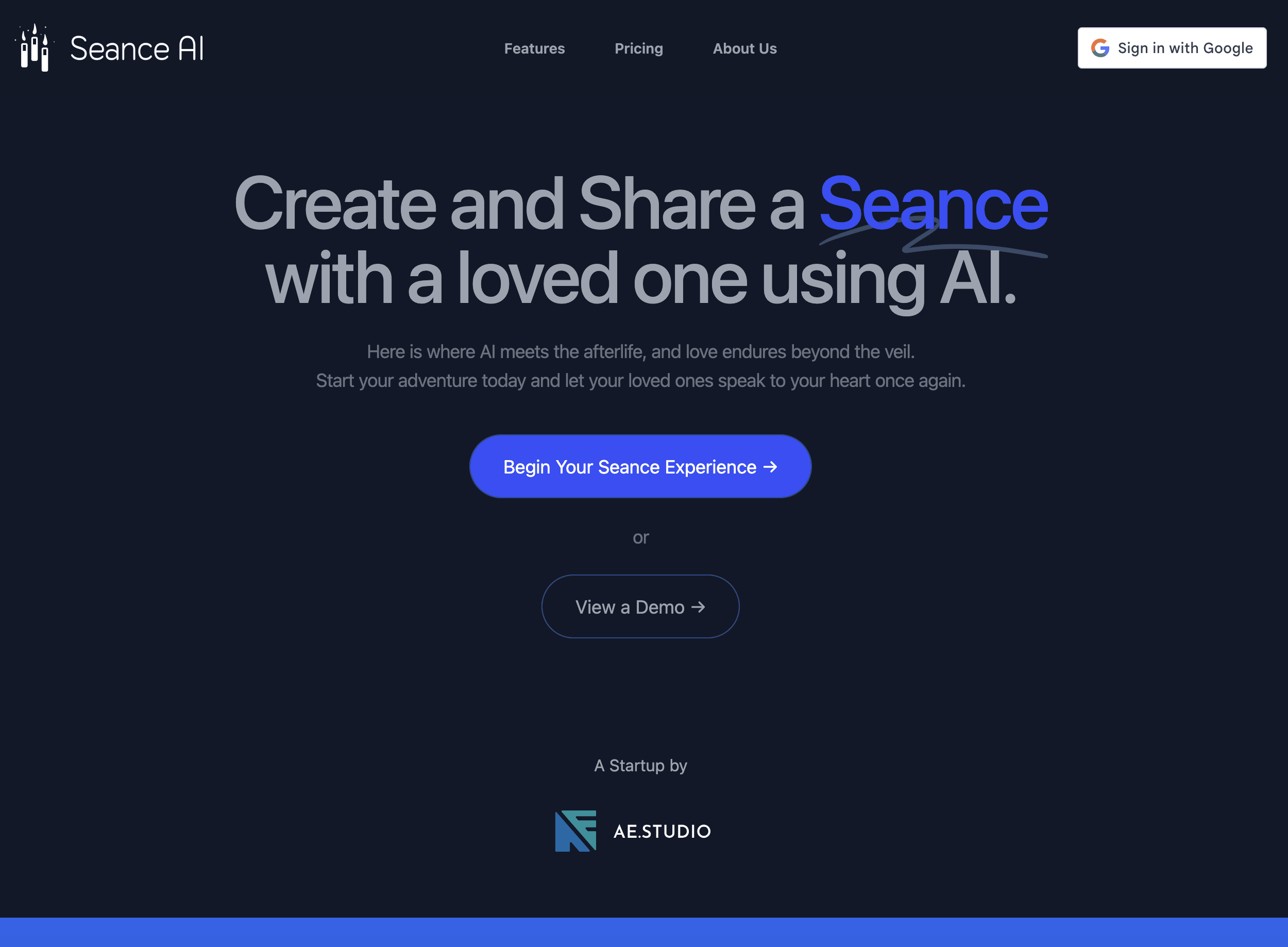
AE Studio built Seance AI, a grief tech application that uses large language models to simulate text-based conversations with deceased loved ones. Designed for emotional closure rather than ongoing use, the app attracted national press coverage from Fox News, Futurism, and The Sun at launch.
TL;DR
- Built an LLM-powered grief tech app using OpenAI's API that simulates text-based conversations with deceased loved ones, trained on user-supplied personality data and writing samples
- Designed intentionally for short, closure-focused sessions with a pay-per-session model to discourage dependency, alongside a premium tier offering voice recreation and animated images
- Earned national press coverage in Fox News, Futurism, and The Sun at launch, sparking a broader public conversation about AI ethics and the future of grief technology
THE CHALLENGE
The problem.
Grief is one of the most universal human experiences, and for centuries people have sought ways to find closure after losing a loved one. Traditional counseling and journaling each serve a purpose, but none address the specific longing for one final conversation with someone who is gone.
With the rapid rise of large language models in 2023, a new possibility emerged: could AI simulate a person's communication style well enough to offer a meaningful, if brief, sense of closure? And if so, how should that experience be designed responsibly?
Most grief tech companies in this space positioned their products as preservation tools, carefully avoiding any language that implied resurrection. AE Studio took a different approach. Rather than obscuring what the technology was doing, the team leaned into the idea directly, naming the product Seance AI and treating transparency as a core design principle.
The challenge was building something emotionally resonant without being exploitative, technically credible without overclaiming, and honest enough about its limitations that users could engage with it in a healthy way.
THE SOLUTION
What we built.
Radical Transparency as a Design Principle
Most grief tech products soften the premise. Seance AI did the opposite. The name was chosen deliberately to signal exactly what the product was: a fictionalized, AI-generated conversation with someone who is no longer alive.
AE Studio explained that the name was intentionally striking. The goal was to draw attention to how advanced large language models had become and to give users a clear-eyed frame for what they were engaging with. A product that admits it is conjuring a digital simulacrum is more honest than one that implies it has captured a soul.
Personality Modeling Through User Input
Seance AI collected a structured set of inputs to build a personality model for the deceased. Users provided the person's name, age, cause of death, personality traits rated on a 1-5 scale, examples of the person's writing style, their relationship to the user, and subjects they wanted to discuss.
Writing samples were the most important input: an old email, a letter, or a text message gave the model a template for vocabulary, tone, and emotional register. The result was a chatbot that could approximate how someone communicated, not just what they might generically say.
GPT-4 Integration and Conversational Interface
The application was powered by GPT-4 via OpenAI's API. Once onboarding inputs were submitted, users were brought to a minimal conversational interface preceded by an animated flame visual that signaled the transition into the seance.
The experience was designed to feel appropriately atmospheric without being overwrought. From there the interaction was straightforward: a text box, a flame, and space for the conversation to unfold.
Intentional Brevity and Closure-Focused Design
Rocks was explicit that Seance AI was not meant for long-term or repeated use. He compared it to a traditional seance: a bounded ritual, not an ongoing relationship. The product was designed to facilitate closure and emotional processing in a single session, not to create a persistent digital version of the deceased.
To reinforce this, the team moved away from a monthly subscription model toward a pay-per-session pricing structure. The logic was direct: making it easy to summon the dead repeatedly would undermine the product's core purpose.
Premium Features: Voice Recreation and Animated Images
Beyond the base text experience, Seance AI's premium tier introduced voice recreation and animated images. For voice, users could upload up to three audio samples of the deceased, each under five minutes, which the system used to reconstruct a voice model.
The animated image feature added subtle movement to photos of the deceased, including gentle eye and head motion. Together these features pushed the experience toward something richer and more sensory while remaining grounded in what the technology could responsibly deliver.
AI Safety as Part of the Product Narrative
Rocks and the AE Studio team were deliberate about grounding the product in a public conversation about AI safety and ethics. Rather than avoid the uncomfortable questions the product raised, they used its visibility to advocate for thoughtful regulation and awareness of what LLMs can and cannot do.
Rocks told Fox News that AE Studio was greatly concerned about AI safety and wanted to draw attention to the potential implications of the technology, while also making clear they supported healthy regulation rather than halting progress. Seance AI was designed to be a demonstration of where AI was heading and an invitation to engage seriously with what that means.
HOW IT WORKS
The details.
Leading With Transparency Instead of Euphemism
The product was intentionally named Seance AI to make the experience explicit from the first interaction. Instead of framing the system as preservation software, the team presented it as a clearly simulated conversation. That transparency shaped product copy, onboarding expectations, and user trust from the start.
Building a Personality Model From Structured Inputs
Users provide key context about the deceased person, including personality traits, writing samples, and relationship details. The writing samples act as the strongest signal for tone and vocabulary. This input package gives the model enough context to generate responses that feel specific to one individual rather than generic chatbot output.
Running the Conversation on GPT-4 With a Focused Interface
After onboarding, the app moves users into a minimal conversational experience powered by GPT-4 through OpenAI's API. The interface stays simple by design: atmospheric transition, text input, and message flow. The implementation favors clarity and emotional readability over feature-heavy interaction patterns.
Designing for Closure With Explicit Usage Limits
The product was designed as a short, bounded experience rather than an always-on relationship. Pricing shifted toward pay-per-session to reinforce one-time or occasional use. Premium capabilities, including voice recreation and animated images, were added as optional enhancements without changing the core closure-first interaction model.
OUTCOMES
What shipped.
Seance AI launched in May 2023 and earned immediate national press coverage. Fox News covered the product in its tech section. Futurism published a first-person review in which a staff writer used the app to simulate a conversation with her late father, describing the first AI response as about 80 percent convincing before the model grew repetitive. The Sun also covered the launch, focusing on the pay-per-session pricing model and the deliberate design choice to limit session length. The coverage sparked a broader public conversation about grief technology, AI ethics, and the implications of LLM-based personality simulation. Seance AI was cited across technology, mental health, and spirituality-adjacent publications, reaching audiences well outside the typical tech press readership. The project demonstrated that AE Studio could move from concept to launched product quickly on a novel, ethically complex brief, and that building at the frontier of AI, done transparently, generates real attention and real conversations.
Featured in Fox News, Futurism, and The Sun at launch
Futurism reviewer found the first AI response approximately 80% convincing in replicating her late father's communication style
Coverage reached technology, mental health, and spirituality-adjacent audiences beyond typical tech press
Sparked public discourse on AI ethics and grief technology cited across multiple publications
KEY TAKEAWAYS
What we learned.
- Radical transparency outperforms euphemism. Naming the product Seance AI and leaning into what it actually did created more trust and more press interest than a softer framing would have.
- Closure-oriented design requires explicit constraints. Building in session brevity and pay-per-session pricing were as important as the technical implementation. The design philosophy was inseparable from the ethics.
- Writing samples are the most important input for personality simulation. User-supplied text from emails, letters, or messages gave the model the vocabulary, tone, and emotional register needed to approximate a specific individual.
- AI safety should be part of the product narrative from day one. Addressing limitations openly, rather than defensively, built credibility and positioned the team well in a rapidly evolving public conversation about LLMs.
- Skunkworks projects can generate disproportionate visibility. A tightly scoped internal build attracted national press and positioned AE Studio as a thought leader in a category that barely existed at the time.
IN SUMMARY
Bottom line.
Seance AI was AE Studio's exploration of one of the most emotionally charged applications of large language models: simulating a conversation with someone who has died. By leading with transparency, designing for closure rather than dependency, and engaging seriously with the ethical dimensions of the product, the team built something that resonated far beyond its technical scope.
The national press coverage and the ongoing conversation the product sparked pointed to the same conclusion: building at the frontier of AI, done thoughtfully, creates real value. Seance AI remains a demonstration of what is possible when technical capability and ethical clarity are treated as complementary rather than competing forces.
KEY TERMS
Terms, defined.
- Grief Tech
- Grief tech is defined as software designed to support people after the death of a loved one, often using digital tools such as conversation interfaces, memory artifacts, or guided rituals for reflection and closure.
- Personality Simulation
- Personality simulation refers to using language models and user-provided context, such as writing samples, traits, and biographical details, to generate responses that approximate how a specific person might communicate.
FAQ
Frequently asked.
What is Seance AI and who built it?
How does Seance AI simulate a deceased person's communication style?
Why was the product designed for short sessions rather than ongoing use?
What did the premium tier include?
How did AE Studio approach the ethical dimensions of building grief tech?
Is Seance AI available to the public?
LET'S TALK
Bring us the hard problem.
We'll bring the team that ships.